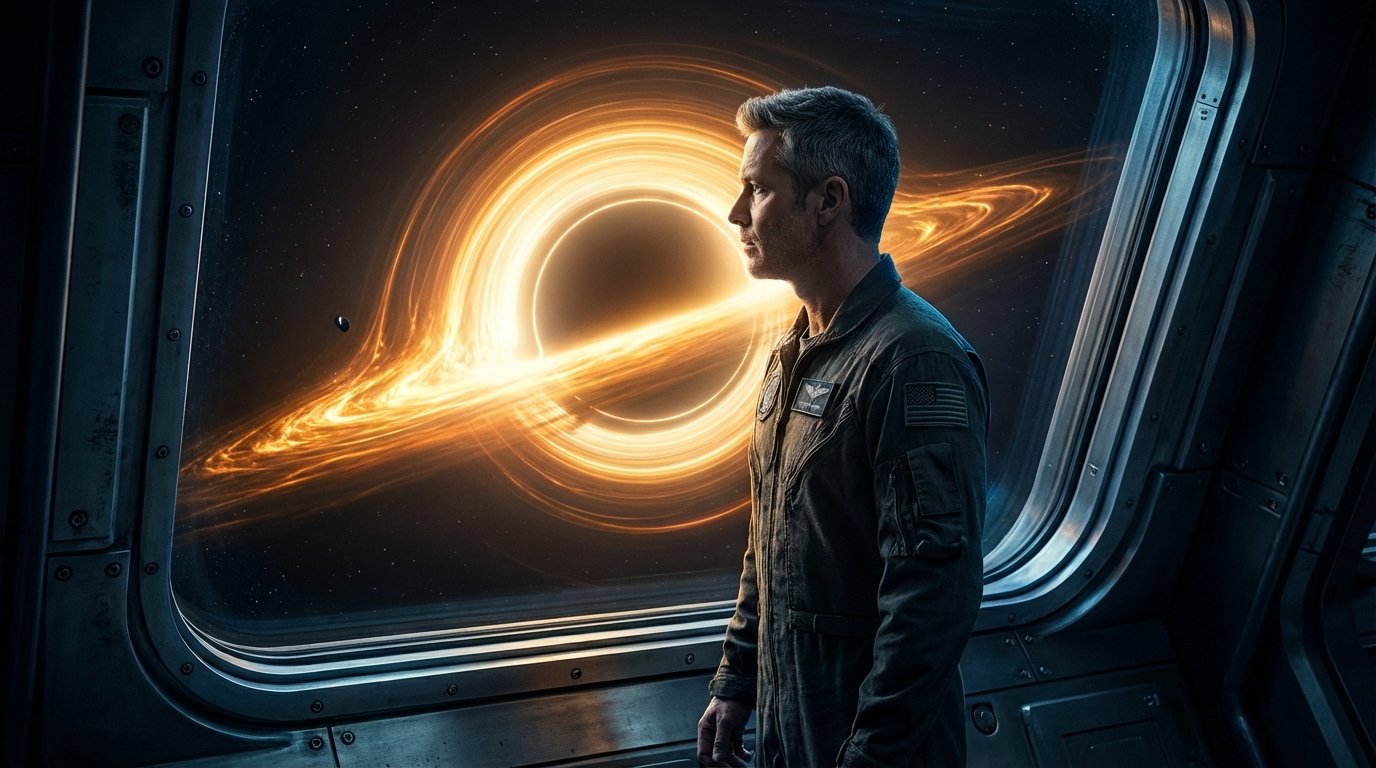
The end of the twenty-sixth century. Humanity has reached the boundaries of the Virgo Supercluster, where the density of matter drops, giving way to the infinite Great Void. Aboard the research complex Icarus-7, drifting near the gravitational anomaly Styx, time and physics obey different laws. In the sterile corridors of the station, among cold titanium and muted light, the crew monitors the event horizon, which threatens to erase the boundaries of the human mind. Astrophysicist Elias Thorne, who voluntarily chose this isolation, searches the structure of the anomaly for proof of the non-randomness of the universe—the only thing that can justify his past mistakes. However, sensory deprivation and the realization of one's own insignificance in the face of eternity begin to destroy the station's fragile social order. In conditions where any technical malfunction is fatal and help from Earth will arrive only in decades, the heroes must find out: is Styx the key to the secrets of the Universe or a mirror reflecting their own madness?
World Setting
The end of the twenty-sixth century. Humanity has reached the outskirts of the Virgo Supercluster, where the density of stars drops critically, giving way to the Great Void. The action unfolds aboard the research complex Icarus-7, drifting near the event horizon of the Styx anomaly—a gravitational lens of unknown origin. The station's interiors are designed in strict functionalism: cold polished titanium, muted light from LED panels, and the eternal, barely perceptible hum of air regeneration systems. An atmosphere of sterile loneliness and scientific fatalism reigns here. Enormous viewing screens broadcast not the familiar starry sky, but warped space, where the light of dying suns stretches into infinite golden threads. The world of Icarus-7 is an environment where human psychology conflicts with the scale of the cosmos. The conflict arises from the realization of one's own insignificance in the face of eternity and physical isolation: any equipment failure or calculation error here is fatal, and help from Earth will arrive only decades later. Social tension within the crew escalates due to sensory deprivation and an ethical dilemma: is it worth continuing to study an anomaly that threatens to erase the boundaries of the human mind?
Character
Elias Thorne (42)
Lean build and pale skin, characteristic of years spent in closed ecosystems. A face with sharp, ascetic features; deep expression lines at the bridge of the nose reveal a habit of constant concentration. Hair is cut as short as possible, with distinct graying at the temples. The gaze is sharp, cold, devoid of emotional involvement. Wears a standard technical crew jumpsuit made of aramid fiber with a personal identifier on the left shoulder.
A former leading astrophysicist at the Lunar Institute, Thorne voluntarily chose the assignment to Icarus-7, effectively signing his own death warrant due to time dilation. His career on Earth ended after an incident at the Tycho station, where due to his calculations—later proven correct but ethically controversial—a laboratory was depressurized to save the residential sector. Elias lives in a state of constant intellectual hunger and deep alienation. He fears not death, but the possibility that the Styx anomaly will turn out to be merely a meaningless physical phenomenon, devoid of higher order. His motivation is to find proof of the universe's non-randomness in the structure of the gravitational lens, which for him is the only way to atone for past mistakes.
At the Event Horizon
The silence aboard Icarus-7 was not absolute. It consisted of the barely perceptible hum of air regenerators and the distant, almost infrasonic roar of the main engines, keeping the station at a safe distance from the gravitational maw of Styx. Elias Thorne stood before the main viewing screen, where the darkness of the Great Void was torn by dazzling golden threads. This was the light of stars that died millions of years ago, their radiation now captured and stretched into infinite loops by the anomaly's lens. Elias touched the cold titanium of the console. His fingers, pale and dry, moved with mechanical precision, adjusting the spectrograph settings. For the rest of the crew, Styx was merely a dangerous neighbor or an object of endless routine work, but for Thorne, it represented the greatest equation in human history. If there was a hidden rhythm within this monstrous deformation of space-time, then his own life and that tragedy on the Moon were not accidental fluctuations of chaos. Data curves crawled across the monitor. The neutrino flux again showed an anomalous spike at a frequency that should have theoretically remained empty. Thorne froze, his sharp gaze fixed on the numbers. This was not an equipment error. Something out there, beyond the event horizon, pulsed with a periodicity resembling an artificial code. Elias felt a familiar intellectual hunger that momentarily drowned out his usual sense of alienation. He knew that any attempt to look deeper could result in a catastrophe for the crew's fragile psyche, but the truth was the only redemption he could afford himself.